Office Relocation Checklist: Moving Your Business to Gulshan, Banani or Tejgaon
Real Estate,Rental Tips 1
Relocating an office is a major milestone for any business. Whether you're expanding your team, upgrading to a more professional workspace, improving accessibility for employees, or reducing operational costs, a successful office move requires careful planning and execution.
A poorly managed relocation can disrupt daily operations, impact employee productivity, and create unnecessary expenses. On the other hand, a well-planned office relocation can improve business efficiency, enhance your company image, and support long-term growth.
In Dhaka, Gulshan, Banani, and Tejgaon remain the top business districts for companies looking for modern office space. Each location offers unique advantages depending on your business goals, budget, and operational requirements.
This comprehensive office relocation checklist will help you plan a smooth transition while ensuring your business remains productive throughout the move.
Why Do Companies Relocate Their Offices?
Businesses relocate offices for many reasons. As organizations grow, their workspace requirements often change.
Some of the most common reasons include:
-
Expanding team size
-
Need for a larger office
-
Better office infrastructure
-
Improved accessibility
-
Lower operational costs
-
Stronger corporate image
-
Access to clients and business partners
-
Upgrading to a premium business location
When Should a Company Relocate Its Office?
A business should consider relocating when the current office no longer supports growth, productivity, employee satisfaction, or operational efficiency. If your team is outgrowing the available space or your location is limiting business opportunities, it may be time to move.
Step 1: Define Your Office Requirements
Before searching for office space, clearly define what your business needs.
Consider the following:
Team Size
Calculate how many employees need workstations today and how many you expect to hire over the next 2–3 years.
Workspace Type
Determine whether you need:
-
Open-plan workspace
-
Private offices
-
Executive cabins
-
Conference rooms
-
Meeting rooms
-
Training areas
Furnished or Unfurnished Office
Decide whether you want:
-
Fully furnished office space
-
Semi-furnished office
-
Bare-shell office space
Furnished offices allow businesses to move quickly, while unfurnished spaces provide more customization options.
Parking Requirements
If employees and clients frequently visit your office, adequate parking is essential.
Budget
Establish a realistic budget for:
-
Monthly rent
-
Service charges
-
Utilities
-
Office fit-out
-
Relocation expenses
Having clear requirements will make the office search process much easier.
Step 2: Choose the Right Business District
Location plays a critical role in business success. The right office location can improve employee convenience, enhance brand perception, and support operational efficiency.
Gulshan: Premium Corporate Address
Gulshan is considered Dhaka's most prestigious business district.
Best for:
-
Multinational companies
-
Financial institutions
-
Corporate headquarters
-
International organizations
Advantages:
-
Premium corporate image
-
Modern office towers
-
International business environment
-
Excellent amenities
Considerations:
-
Higher rental costs
-
Limited affordability for startups
Banani: Balanced Business Environment
Banani offers a balance between prestige and affordability.
Best for:
-
SMEs
-
Consulting firms
-
Marketing agencies
-
Service-based businesses
Advantages:
-
Strong business community
-
Convenient location
-
Professional environment
Considerations:
-
Moderate rental rates
-
Limited availability in prime buildings
Tejgaon: Fast-Growing Commercial Hub
Tejgaon has become one of Dhaka's most attractive commercial areas.
Best for:
-
IT companies
-
E-commerce businesses
-
Logistics firms
-
Startups
-
Growing enterprises
Advantages:
-
Competitive rental costs
-
Central location
-
Excellent connectivity
-
Strong expansion potential
Considerations:
-
Lower prestige compared to Gulshan
Step 3: Set an Office Relocation Budget
One of the most common relocation mistakes is underestimating costs.
Create a detailed relocation budget before signing a lease.
|
Expense Category |
Example Costs |
|
Security Deposit |
Advance rent |
|
Moving Services |
Equipment transportation |
|
Furniture |
Desks and workstations |
|
Internet Setup |
Installation fees |
|
Interior Work |
Branding and fit-out |
|
Utilities |
Electricity and service charges |
|
Technology Setup |
Network and server installation |
Having a budget helps avoid unexpected expenses during the relocation process.
Step 4: Review the Office Lease Carefully
Before finalizing any office space, review the lease agreement thoroughly.
Important Lease Terms to Check
✔ Monthly rent
✔ Service charges
✔ Security deposit
✔ Rent escalation clauses
✔ Lease duration
✔ Parking policies
✔ Maintenance responsibilities
✔ Exit clauses
✔ Renewal terms
What Should Businesses Check Before Signing an Office Lease?
Businesses should carefully review rental costs, service charges, lease duration, maintenance responsibilities, security deposits, and renewal terms before signing an office lease agreement.
A clear understanding of lease conditions can prevent future disputes and unexpected costs.
Step 5: Plan Your IT and Infrastructure Setup
Technology infrastructure is critical for business continuity.
Create an IT migration plan before moving.
Checklist:
-
High-speed internet installation
-
LAN configuration
-
Wi-Fi setup
-
CCTV installation
-
Access control systems
-
Server relocation
-
Cloud backup verification
-
Telephone systems
Schedule installations before employees arrive at the new office.
This minimizes downtime and ensures uninterrupted operations.
Step 6: Inform Employees, Clients, and Vendors
Communication is one of the most important parts of an office relocation.
Notify stakeholders well in advance.
Employee Communication
Inform employees about:
-
New office address
-
Moving timeline
-
Transportation options
-
Parking facilities
-
New office policies
Client Communication
Notify clients through:
-
Email announcements
-
Website updates
-
Social media channels
-
Newsletters
Vendor Communication
Update:
-
Suppliers
-
Courier services
-
Maintenance providers
-
Utility providers
Keeping everyone informed helps avoid confusion and business disruptions.
Step 7: Organize Furniture and Workspace Layout
An office move is the perfect opportunity to optimize workspace design.
Review:
-
Workstation layout
-
Department placement
-
Meeting rooms
-
Collaboration zones
-
Reception area
-
Executive offices
A well-designed office improves employee productivity and creates a professional environment for clients.
If you're moving into an unfurnished office, develop a furniture installation plan before relocation day.
Step 8: Test Everything Before Moving Day
Before officially opening the new office, conduct a complete inspection.
Pre-Move Testing Checklist
✔ Internet connection
✔ Electricity
✔ Backup generators
✔ Access cards
✔ CCTV systems
✔ Meeting room technology
✔ Air conditioning
✔ Fire safety systems
✔ Water supply
✔ Security systems
Identifying problems before employees arrive can prevent major disruptions.
Common Office Relocation Mistakes to Avoid
Many businesses encounter avoidable issues during relocation.
Choosing an Office Based Only on Rent
The cheapest office may not provide the best long-term value.
Consider:
-
Accessibility
-
Infrastructure
-
Employee convenience
-
Future growth potential
Ignoring Employee Commute
Long commuting times can affect employee satisfaction and retention.
Underestimating Relocation Costs
Always include contingency funds in your relocation budget.
Delaying Internet Installation
Internet delays are among the most common causes of post-relocation downtime.
Not Planning for Future Growth
Choose an office that can accommodate future expansion.
Office Relocation Timeline: A Practical 30-Day Plan
30 Days Before Moving
-
Select office location
-
Sign lease agreement
-
Create relocation plan
-
Hire moving service
15 Days Before Moving
-
Setup internet services
-
Plan office layout
-
Notify clients and vendors
-
Schedule IT migration
7 Days Before Moving
-
Pack equipment
-
Label furniture
-
Finalize employee instructions
-
Verify infrastructure readiness
Moving Day
-
Transfer equipment
-
Inspect office
-
Test systems
-
Verify security access
First Week After Moving
-
Resolve operational issues
-
Collect employee feedback
-
Update business directories
-
Optimize workspace setup
Gulshan vs Banani vs Tejgaon: Which Area Is Right for You?
|
Feature |
Gulshan |
Banani |
Tejgaon |
|
Corporate Prestige |
★★★★★ |
★★★★☆ |
★★★☆☆ |
|
Cost Efficiency |
★★☆☆☆ |
★★★☆☆ |
★★★★★ |
|
Accessibility |
★★★★☆ |
★★★★☆ |
★★★★★ |
|
Expansion Potential |
★★★☆☆ |
★★★☆☆ |
★★★★★ |
|
Startup Friendly |
★★☆☆☆ |
★★★★☆ |
★★★★★ |
Recommended By Business Type
Choose Gulshan if:
-
You need a premium corporate image.
-
You frequently host international clients.
-
Brand perception is a priority.
Choose Banani if:
-
You want a balance of prestige and affordability.
-
You operate a service-based business.
Choose Tejgaon if:
-
You prioritize value and scalability.
-
You operate an IT, eCommerce, or logistics company.
-
You expect rapid business growth.
Conclusion
Office relocation is more than simply moving desks and equipment. It is a strategic business decision that can directly impact productivity, employee satisfaction, operational efficiency, and future growth.
By following a structured relocation checklist, businesses can minimize disruptions and ensure a smooth transition to their new workspace.
Whether you are relocating to Gulshan for prestige, Banani for balance, or Tejgaon for growth opportunities, careful planning is the key to a successful move.
Choosing the right office location today can create significant advantages for your business in the years ahead.
Frequently Asked Questions
How long does an office relocation take?
Most office relocations require between two and six weeks depending on office size, infrastructure requirements, and preparation.
What is the average office relocation cost in Dhaka?
Costs vary based on office size, moving services, furniture requirements, and technology setup. Businesses should prepare a detailed relocation budget before moving.
Should I choose a furnished or unfurnished office?
Furnished offices are ideal for faster setup, while unfurnished offices provide greater customization and branding flexibility.
Is Gulshan better than Banani for corporate offices?
Gulshan offers higher prestige and international appeal, while Banani provides a more cost-effective option with a strong business environment.
Why are companies moving to Tejgaon?
Companies are choosing Tejgaon because of its central location, competitive office rents, modern infrastructure, and expansion opportunities.
How can businesses reduce office relocation downtime?
Planning early, installing IT infrastructure before moving day, and communicating clearly with employees and clients can significantly reduce downtime.
Related Blogs
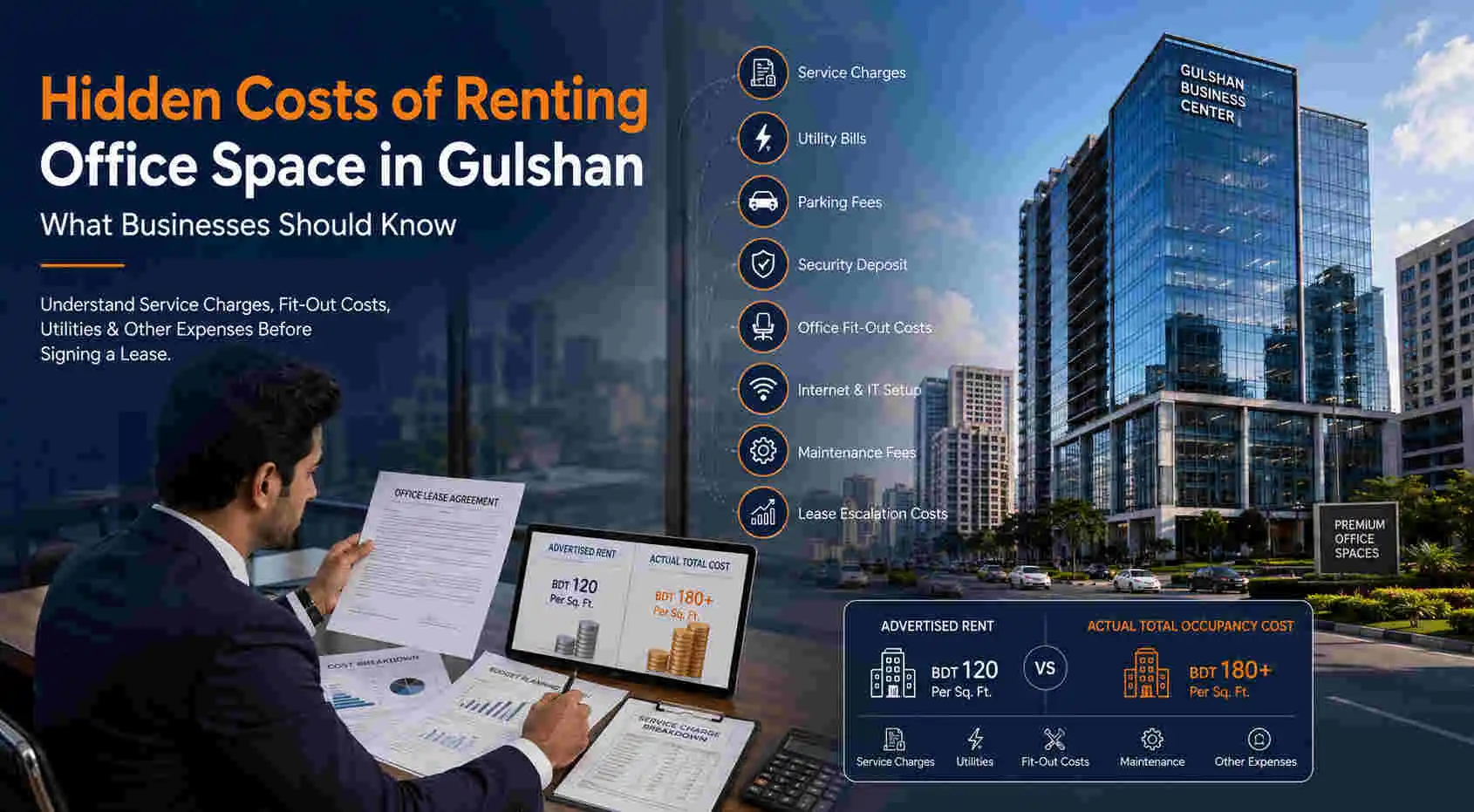
Hidden Costs of Renting Office Space in Gulshan: What Busine...
Gulshan is widely recognized as Dhaka’s premier business district. Home to multinational companies, financial institutions, embassies, and corporate headquarters, the area...
Continue Reading